It's nine at night. Phone in one hand, dinner plate in the other. A text just came in: a customer wants a price on a patio. And you know two things at once — the fastest responder wins the job, and if you sit down to write that quote right now, there goes another evening.
That moment is not a technology problem. It's an attention problem. And that's where I want to start this blog, because everything else — artificial intelligence, agents, servers, automatic quotes — hangs off one thing: how clear your head is when you give an order.
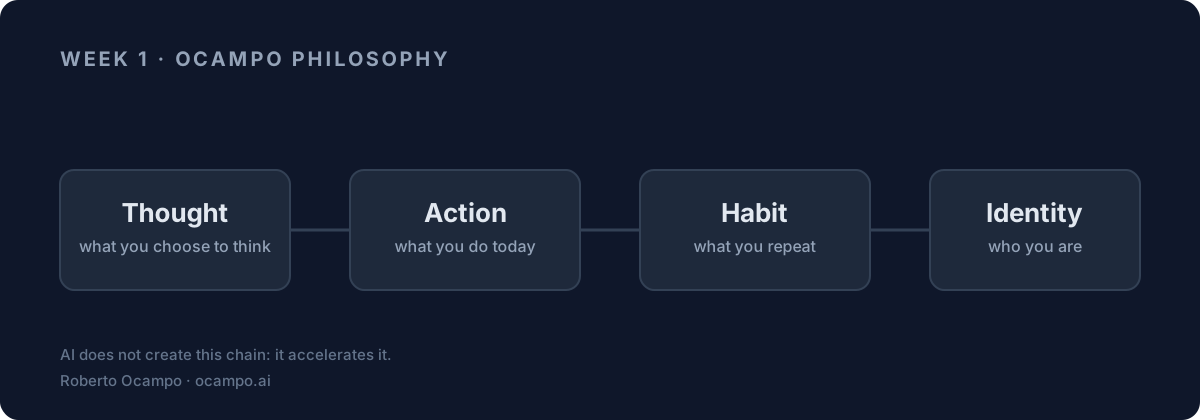
Guard your thoughts, for they define your actions. Your actions become habits, and your habits reveal who you are.
That's my motto. I didn't put it on a coffee mug. I use it to run a business, to keep infrastructure online, and — for several years now — to instruct machines. It turns out the mechanism is exactly the same in all three cases.
The chain you're already running
Thought → action → habit → identity. It's a chain, and it's already running in your business whether you ever named it or not.
The thought "I have to answer everything personally or it feels cold" becomes the action of answering at nine at night. Repeated forty times, that action becomes the habit of being permanently available. And that habit ends up revealing an identity: you're the owner who can't take a vacation.
Change the first link and the whole chain moves. The thought "my job is to decide, not to type" becomes the action of writing down, once and calmly, exactly how a patio gets quoted in your business. Repeated, it becomes the habit of leaving systems standing instead of putting out fires. And that identity — the owner who directs — is the only one that survives growth.
AI doesn't create that chain. It accelerates it. That's why it rewards the disciplined mind and punishes the scattered one: it multiplies whatever you hand it, clarity or clutter.
Instructing a machine looks a lot like building a habit
When people hear "artificial intelligence" they picture magic. What's actually there is a very fast, very well-read assistant that read every manual in your trade but has never set foot on your job site. It doesn't know that in your area hauling is billed separately. It doesn't know you don't work Sundays. It doesn't know your oldest customer pays net thirty.
You're still the boss. And like any boss, your results depend on the quality of the order you give.
You're going to hear this a lot around here: a clear order produces clean work. It's the same truth you already know with your crew. Send someone out to "fix up the yard" and you have no idea what you'll come back to. Send them to "cut to two inches, edge the sidewalk, bag it and haul it before five today" and you know exactly what to expect — and you can check whether it happened.
The difference with a machine is scale. You explain to your crew once a day. You explain to a well-instructed system once, and it obeys at nine at night, in two languages, a thousand times, without getting tired. That's why one hour spent thinking an instruction through is worth more than ten hours of answering by hand.
And it's why mistakes multiply the same way. A sloppy instruction doesn't give you one sloppy result — it gives you two hundred sloppy results, delivered to two hundred customers. Discipline stops being a moral virtue and becomes a measurable operating advantage.
Who's talking to you
My name is Roberto Ocampo. I live and work here, in the Wenatchee Valley.
I'm not an AI salesman who watched a video last week. I'm a programmer, an architect, and — I'll say it without flinching — a philosopher: I need to understand why something works before I build on top of it. I've spent more than twenty years in networking and data centers. I keep one of the valley's largest fruit operations online. I'm building SmartBin, the technology that will modernize that same industry. And I own a service business just like yours: Ivania Photo Studio, where I use all of this every day, on my own evenings, with my own customers.
I describe myself as "the man in the middle": I own both the logic and the operation. I pull technology from every sidewalk — from language models to my own servers humming in my lab — and I build large projects with it, projects that then have to stay up in production, with real customers who call when something breaks.
I tell you this not to show off, but so you know where I'm speaking from: from the inside. I'm not going to sell you dependence. I'm going to teach you capability.
Three thinking habits for this week
You don't need to buy anything to start. Start with the links you already have.
One: write the order before you give it. Your next quote, your next difficult email, your next post — before you write it, put down three lines: what you want to achieve, with what information, and what the finished result should look like. You'll find that half of what people call "AI problems" are really orders they never finished thinking through.
Two: name what repeats. For one week, write down every task you did more than three times. That list is, literally, your automation plan. You don't have to guess where to start: whatever repeats gets delegated first.
Three: separate deciding from typing. At the end of the day, mark which part was your judgment — what price, which customer, what risk — and which part was pure keyboard. The first one is your business. The second is work a well-instructed machine can already do for you.
Do that for a week, with no technology involved, and you've already changed the first link in the chain.
What's coming over the next fifteen weeks
This blog starts today and will publish one entry every Wednesday for fifteen weeks, in English and in Spanish, never mixing the two.
We'll go in order, from simple to serious: what AI actually is and isn't; how to write a work order for a machine; the five pillars I use to launch any task; how to teach an AI the prices and policies of your business; what an agent is and how it differs from an assistant; how to chain tasks so one feeds the next; how to plug all of it into your calendar and your email; why owning your infrastructure beats renting it; and two real cases told from the inside, with their numbers and their stumbles.
By the end you'll be able to put a number on all of it: how many hours it hands back, how many jobs it wins, what it costs.
But the starting point is today, and it's free: mind the thought you begin with. Everything else — the actions, the habits, and eventually the business you become — follows behind it.
See you next Wednesday.
Want to build it with us?
This is exactly what we teach —and build with you— in Cohorte 2026. You walk out with a finished AI project that Ocampo-Infra can run for you. Grab the free guide and claim your seat.
Roberto Ocampo · ro@ocampo.ai · https://ocampo.ai